
GETTING STARTED · MATERIALS & UPKEEP
Can AMS lite print TPU? What A1 mini buyers should know
Yes, with a specifically supported formulation such as Bambu TPU for AMS. Ordinary TPU is a different case: Bambu’s AMS lite specifications exclude generic TPU, while its TPU 95A HF product page explicitly excludes AMS lite use. Do not treat the word “TPU” alone as proof that a spool can pass through the automatic feeder.
You also do not need to buy AMS lite simply to explore compatible, single-color TPU printing on an A1 mini. Bambu documents an external-spool route for flexible materials. The important decision is which material and loading method your project actually needs.
Published November 26, 2026. Manufacturer information checked November 26, 2026. This article explains documented compatibility, not hands-on testing or measured print performance.
First, what are TPU and AMS lite?
TPU stands for thermoplastic polyurethane. It is a family of printing materials used when a project calls for flexibility rather than the behavior of a typical rigid plastic.
“Flexible” covers a range of materials. It does not mean every spool will produce the same softness or require the same setup.
Filament is the plastic strand supplied on a reel, or spool. The printer feeds it into heated components and builds an object in layers.
AMS lite is an automatic material-feeding accessory. It selects filament from multiple spools for supported printing workflows. It is separate from the printer itself.
An external spool sits on the printer’s prescribed spool holder and uses the documented loading route without feeding through AMS lite.
Our illustrated beginner’s glossary explains the extruder, nozzle, spool and other parts you will encounter.
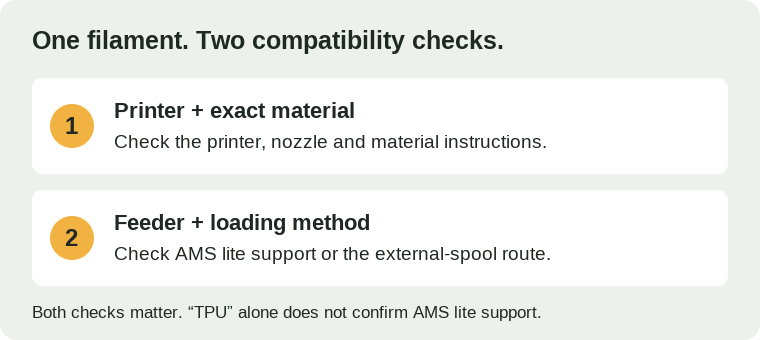
Printer compatibility and feeder compatibility are separate checks
A printer can support a material without supporting that material through every accessory.
Bambu lists TPU among the A1 mini’s supported material examples. That describes the printer’s capability, rather than blanket approval for every TPU formulation or feeding route.
Think of two questions:
- Can the printer process this exact material?
- Can the chosen feeder reliably deliver it using the approved procedure?
You need satisfactory answers to both.
| Material or situation | Documented compatibility | Before buying |
|---|---|---|
| Generic TPU | AMS lite’s specification table lists it as unsupported. | Verify a suitable external-spool workflow and printer profile. |
| Bambu TPU 95A HF | Its product page explicitly excludes AMS and AMS lite. | Do not purchase it expecting automatic feeding. |
| Bambu TPU for AMS | Its product page explicitly includes AMS lite compatibility. | Check the remaining nozzle, plate and preparation requirements. |
| An unfamiliar “AMS-compatible” spool | The wording alone does not establish compatibility with your exact setup. | Find explicit support for AMS lite and your printer. |
These distinctions come from Bambu’s material pages and AMS lite specifications. They are not our results from testing the spools.
Why does some advice say TPU cannot use AMS lite?
Some instructions give a broad warning about flexible materials. Product-specific documentation makes a narrower distinction.
For example, Bambu’s A1 mini Combo quick-start guidance directs flexible materials to the external spool. Meanwhile, the inspected AMS lite specification table names TPU for AMS as supported, and that filament’s own product page expressly includes AMS lite.
The practical lesson is to read the complete filament name, the exact feeder model and the applicable instructions together.
If documents disagree about your intended combination, ask Bambu to confirm it before buying. A forum success story does not resolve a manufacturer restriction.
Does “TPU for AMS” mean the finished part will feel like soft rubber?
Not necessarily. Compatibility with a feeder is one property; the behavior of the printed object is another.
Bambu’s technical data sheet identifies TPU for AMS with a Shore hardness of 68D. Shore hardness describes resistance to indentation. The letter is part of the designation, so do not compare “68D” and “95A” as though they were numbers on one identical scale.
The manufacturer also explains that wall and internal-fill settings affect the elasticity of printed TPU parts.
Walls are the outer layers forming a part’s shell. Infill is the structure inside it.
For example, a thin protective sleeve and a thick, densely filled block can behave differently even when made from the same spool.
Before buying material for a soft grip, a flexible cover or a prototype bumper, decide how much bending you need. Do not choose a filament solely because it fits the automatic feeder.
Do you need the Combo for your first flexible project?
If your goal is a compatible one-color flexible part, investigate the external-spool method first.
Suppose you want to prototype a small protective cover. Your main questions are its dimensions, material behavior and supported printing settings. Automatic color changes may add little value to that particular project.
If you regularly want multicolor work using a specifically approved formulation, the accessory may serve a clearer purpose.
Our single-color versus multicolor guide explains the wider trade-offs.
Also check the exact purchase package. The site’s reviewed A1 mini selection includes an LED lamp kit. That lighting accessory does not establish that AMS lite is included.
Check the nozzle, printing surface and drying requirements too
The feed path is only one part of preparation.
A nozzle is the small outlet that deposits softened plastic. A build plate is the surface supporting the object.
For TPU for AMS, Bambu’s technical sheet lists particular nozzle sizes, suitable plate types, surface preparation and drying conditions. It also warns that its laboratory property values do not guarantee the performance of every printed design.
Follow the instructions for the actual material and equipment. Do not substitute a drying temperature, plate recommendation or software setting from another TPU product.
A slicer profile is a saved group of printing settings. Confirm that the selected profile matches your printer, nozzle and filament before preparing the job.
For budgeting, include the supplies and preparation equipment your chosen workflow requires. Our running-cost guide helps you compare complete projects rather than spool prices alone.
Start with a small, low-consequence project
Use the first suitable design to learn loading, preparation and removal before committing to an important part.
For workplace prototyping, distinguish a model used to explore shape or feel from a component expected to perform a critical function. Printing a flexible shape does not validate its load capacity or durability.
Keep hot components, moving parts and emissions in your workspace plan. NIOSH identifies these among the hazards to assess when using 3D printers. Our workspace safety guide provides a starting point alongside the manufacturer’s instructions.
What should you choose?
- Mostly one-color flexible projects: Check a documented external-spool workflow before paying for automatic color hardware.
- Multicolor projects with an approved formulation: Check explicit AMS lite compatibility and the complete material instructions.
- A particular softness or mechanical behavior: Choose around that requirement, rather than assuming all TPU feels alike.
- An unresolved compatibility claim: Obtain confirmation before ordering.
Use our printer comparison to examine the broader options, or try the Printer Finder to narrow your shortlist around your projects.
Sources and further reading
- Bambu TPU for AMS product information
- Bambu TPU 95A HF product information
- Bambu manual: section 31, AMS lite specifications
- Bambu TPU for AMS technical data sheet
- A1 mini Combo quick-start guide
- NIOSH: Approaches to safe 3D printing
The AMS lite specification table is in an A2L manual and is used here only for the shared accessory’s material list. A1 mini loading procedures come from its own quick-start guide. Confirm your exact combination against current instructions.