
KIDS & FAMILIES · MATERIALS & UPKEEP
Can Toybox use regular PLA filament? A parent’s guide to refills
Yes. Toybox’s current support guidance permits third-party 1.75 mm PLA filament. You do not have to buy only its branded Printer Food. However, that does not guarantee that every roll labeled PLA will feed or print equally well. Toybox warns about inconsistent material and diameter, and advises avoiding third-party filament containing specks, flecks or glitter because of clogging concerns. Read Toybox’s support guidance.
If you are buying a Toybox for your child, this helps answer an important ownership question: what happens when the included material runs out?
Here is how to understand the label, compare refill costs and decide what to check before ordering.
Published November 25, 2026. Manufacturer information checked November 25, 2026. This guide is based on documentation, not hands-on testing or comparisons of filament brands.
What is Toybox “Printer Food”?
Printer Food is Toybox’s name for its printing filament. It is plastic material that the machine uses to build objects, rather than paper or ink.
Toybox identifies its material as PLA, short for polylactic acid. The playful product names do not make it edible: Toybox explicitly says Printer Food is not food for people. Toybox’s material explanation.
A spool is the reel holding the plastic strand. During printing, the machine feeds that strand into its heated printing components and places the softened material in layers.
For unfamiliar words, our 3D printing glossary for beginners explains filament, the extruder, the nozzle and the printing surface.
What does “1.75 mm” mean?
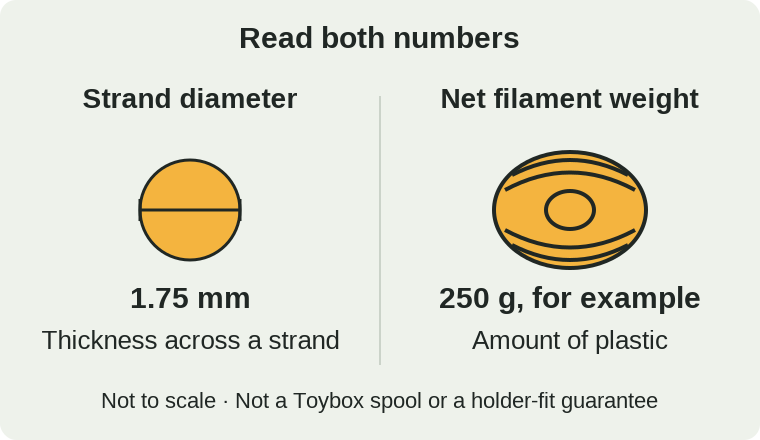
It describes the thickness of the filament strand, measured across it.
It does not describe:
- The diameter of the whole spool.
- The amount of plastic in the package.
- The size of the finished toy.
- The opening in the printer’s nozzle.
Those are separate measurements. Two packages can contain the same thickness of filament while holding very different amounts of plastic.
For example, 250 g describes material weight. 1.75 mm describes strand diameter. One number cannot replace the other when checking a refill.
Does another brand affect the warranty?
Toybox’s current third-party-filament support page says using another brand will not void the warranty. The same page specifies the required material and size, and does not recommend a particular outside brand.
That statement should not be read as a promise that every problem or replacement will be covered. Before buying, check the warranty applying to your exact printer and seller, and keep your purchase records.
Our Toybox Alpha Four review separates the reviewed model from older Toybox generations. Older reviews can provide background, but current support instructions should guide today’s refill decision.
Will a larger spool fit the Toybox holder?
Material compatibility and physical spool fit are different questions.
A label can identify the right printing material without establishing whether its reel fits the supplied holder or feeds correctly from it.
I did not establish a published maximum third-party spool diameter, width or weight for the Alpha Four from the official sources checked. Consequently, this guide does not promise that a particular 1 kg reel fits.
Before ordering a larger roll, ask Toybox about its compatibility with your exact printer and holder. Provide the reel’s dimensions as well as the material label. Avoid treating an improvised holder arrangement as manufacturer-approved.
For a first refill, buying a modest quantity also limits how much unused material you have if the feeding arrangement proves inconvenient.
How do you compare refill costs fairly?
Compare the amount of filament, not just the price of the roll.
Price per 100 g = delivered refill price ÷ filament weight in grams × 100
Here is a deliberately hypothetical example:
| Example refill | Example price | Material weight | Price per 100 g |
|---|---|---|---|
| Small roll | $12 | 250 g | $4.80 |
| Larger roll | $24 | 1,000 g | $2.40 |
These are invented calculation examples, not current Toybox or Amazon prices.
The larger roll costs more at checkout but less per unit of material. That advantage matters only if it is suitable for your printer and you will use it.
Check that the advertised weight means filament weight, rather than the combined weight of the plastic and its reel. Include delivery charges consistently when comparing offers.
For a family that wants several colors, smaller rolls might still suit the budget better than buying large quantities of each color.
A cheaper roll does not guarantee cheaper finished toys
Imagine purchasing a large roll to make occasional birthday decorations. A lower price per gram may offer little practical benefit if most of the roll remains unused.
Conversely, a household making the same small project regularly may place more value on dependable refills and a predictable routine.
Track what you actually spend on successful projects, including discarded attempts and necessary supplies. Our guide to 3D printer running costs explains how to build a fuller budget.
There is no tested savings figure or reliability ranking for third-party Toybox filament in this article.
Changing refills remains an adult-supervised task
A child-focused printer still has hot components.
The Alpha Four manual warns against touching the nozzle, including when the machine is not operating, and identifies small printed pieces as choking hazards. It also requires an adult to install and remove the power supply. Follow the full Alpha Four manual, including cooling and handling instructions.
Plan for an adult to manage loading, troubleshoot feeding problems and assess the finished objects.
Material branding also does not settle workspace safety. NIOSH identifies particle and chemical emissions among potential 3D-printing hazards and discusses appropriate exposure controls. Consult our workspace safety guide alongside the manufacturer’s instructions.
What should you check before buying?
For a printer purchase or the next refill, write down:
- The exact Toybox model you own or intend to buy.
- The refill’s material, strand diameter and net filament weight.
- Whether its physical reel fits the documented feeding arrangement.
- The delivered cost per 100 g.
- The adult responsible for loading and troubleshooting.
Keep unresolved questions on our free parent’s buying checklist, or download the two-page PDF.
If you are still choosing a machine, explore manufacturer-designated printers for children, compare their documented features in the printer comparison table, or use the Printer Finder.
Choose the printer and its supplies around the projects your family wants to make, the recurring costs you can manage and the help an adult is ready to provide.